
Are you ready to embark on an incredible journey through the cosmos? Do you dream of gazing at distant galaxies, the majestic rings of Saturn, or the rugged craters of the Moon? If so, you’ve come to the right place! In this comprehensive, 2000-word guide, we’ll dive deep into the world of backyard astronomy, exploring the best telescopes on Amazon and helping you choose the perfect instrument to unlock the wonders of the night sky.
Stargazing is more than just a hobby; it’s a profound connection to the universe. It sparks curiosity, inspires awe, and offers a deep sense of perspective that few activities can match. Whether you’re a seasoned astronomical observer or a complete beginner looking to make your first celestial sighting, owning a quality astronomical telescope can utterly transform your view of reality.
But let’s be honest: the world of telescopes can be a confusing maze. With terms like aperture, focal length, reflector, and equatorial mount being tossed around, it’s easy to feel overwhelmed. That’s why we, the team at MindGearMen, have done the heavy lifting. We’ve meticulously researched countless specifications and Amazon customer reviews to bring you the definitive list of the top 5 telescopes on Amazon that consistently deliver exceptional performance, ease of use, and incredible value for US stargazers.
Get ready to discover the optical gear that will elevate your stargazing adventures. Let’s illuminate the cosmos!
Table of Contents
Why the Right Telescope is Your Gateway to Discovery
Before selecting your instrument, let’s solidify why this investment matters. A telescope is a powerful scientific tool that dramatically extends human vision. Its fundamental purpose is twofold: to collect light and to magnify the image.
The Crucial Role of Aperture (Light Collection)
If you take away one thing from this guide, it should be this: Aperture is King. The aperture is simply the diameter of the telescope’s primary light-gathering component—the main lens or mirror.
The larger the aperture, the more light the telescope collects. More light means:
- Brighter Images: Especially vital for viewing faint deep-sky objects (DSOs) like nebulae and galaxies.
- Higher Resolution: The ability to discern finer details, such as the subtle cloud bands on Jupiter or the intricate star fields in a cluster.
When buying a beginner telescope, many focus on magnification (power), but an 8-inch telescope showing a clear, bright image at 100x magnification is infinitely better than a 2-inch telescope showing a dark, blurry image at 500x. Don’t chase high numbers; chase large aperture!
Understanding Magnification and Focal Length
Magnification power is determined by the telescope’s focal length and the eyepiece’s focal length using a simple formula:
Magnification=Eyepiece Focal Length / Telescope Focal Length
For example, a telescope with a 1000mm focal length using a 10mm eyepiece provides 100x magnification. Your telescope will come with several eyepieces, allowing you to switch between low power (for finding objects and wide-field views) and high power (for planetary detail).
Pro Tip: As a general rule for most amateur telescopes, you should rarely push your magnification beyond 50x per inch of aperture. Exceeding this limit usually just magnifies the atmospheric turbulence and blurriness.
The Three Main Types of Telescopes
Telescopes fall into three optical categories. Knowing the difference will help you understand which of the top 5 telescopes on Amazon is best for your viewing style:
1. Refractor Telescopes (The Classic Look)
- How they work: Use lenses at the front to bend (refract) light to a focal point at the back.
- Pros: Crisp, high-contrast images; virtually maintenance-free (no mirror alignment needed); excellent for lunar and planetary viewing.
- Cons: Can suffer from chromatic aberration (color fringing around bright objects) unless expensive glass is used; very expensive to make with large apertures.
2. Reflector Telescopes (Light Buckets)
- How they work: Use a large parabolic mirror at the back to gather and reflect light back up to a smaller, secondary mirror near the front, which redirects the image to the eyepiece.
- Pros: Best performance-to-cost ratio; largest apertures are achievable at affordable prices; ideal for observing faint deep-sky objects.
- Cons: Require occasional mirror alignment (collimation); the secondary mirror can slightly obstruct light.
3. Catadioptric Telescopes (Hybrids)
- How they work: Combine mirrors and lenses (like Schmidt-Cassegrains) to fold the light path.
- Pros: Very compact and portable for their aperture; excellent for astrophotography.
- Cons: More complex and expensive; requires alignment of multiple elements. (None of the top 5 entry-level picks are this type, but it’s important to know!)
Choosing Your Mount: Alt-Az vs. Equatorial
The mount is just as important as the optics, as a wobbly mount makes high-magnification viewing impossible.
Alt-Azimuth (Alt-Az) Mounts
- Best For: Beginners, terrestrial viewing, and casual stargazing.
- Function: Moves simply Up-Down (Altitude) and Left-Right (Azimuth). Intuitive, like a camera tripod.
- Benefit: Easy to set up and navigate.
Equatorial (EQ) Mounts
- Best For: Serious observers and astrophotography.
- Function: Aligns with the North Celestial Pole (Polaris), allowing you to track celestial objects by turning a single knob to compensate for the Earth’s rotation.
- Benefit: Keeps the target perfectly centered, crucial for long-exposure photography and high-power viewing.
- Drawback: Requires a learning curve and precise polar alignment.
The Definitive List: Top 5 Telescopes on Amazon
We assessed these top telescopes based on optics, mount stability, ease of use, accessory package, and overall value.
1. Celestron StarSense Explorer LT 114AZ Telescope (Best for Guided Learning)
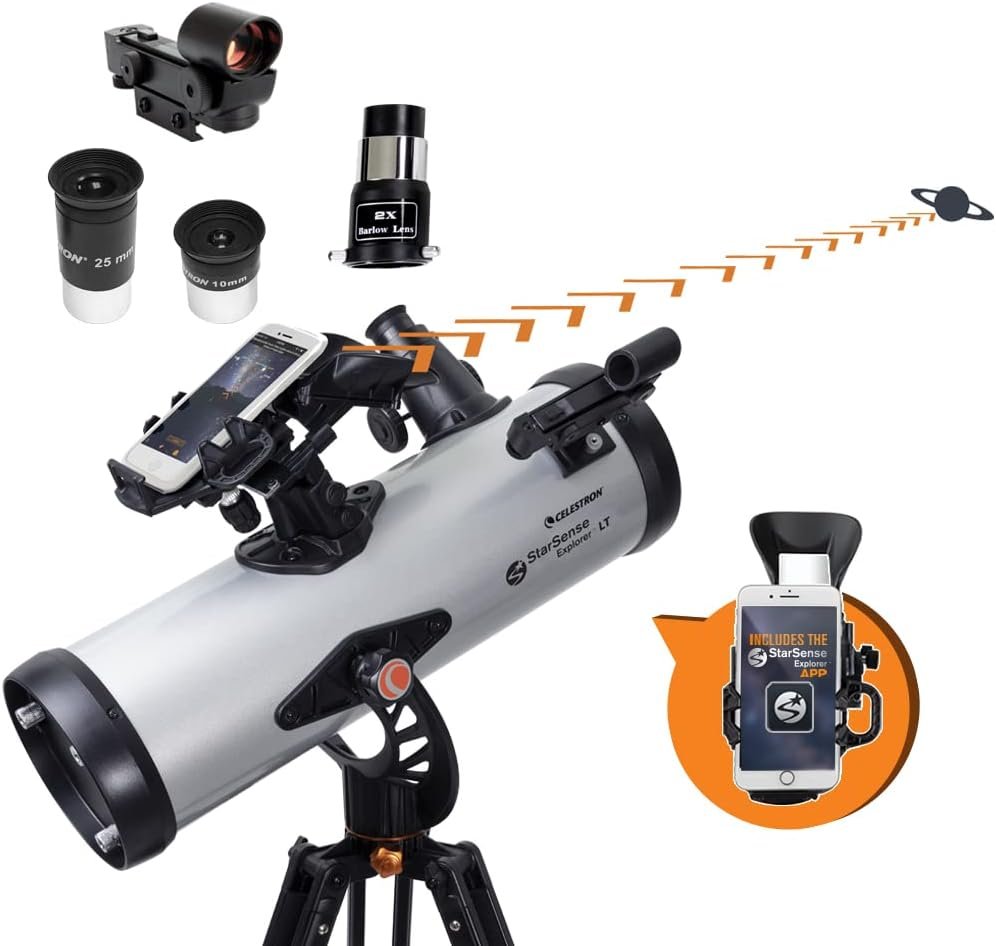
The StarSense Explorer LT 114AZ completely eliminates the beginner’s curse: finding things in the sky. This telescope is a revolutionary bridge between modern technology and optical astronomy.
Elaboration:
While many starter telescopes are difficult to point accurately, the StarSense app uses your smartphone’s camera, GPS, and accelerometers to perform a lightning-fast plate solve. It effectively identifies the exact portion of the sky the telescope is viewing. You simply follow the guiding arrows on your phone screen—a process far simpler than squinting through a basic finderscope. This Celestron telescope uses a 114mm Newtonian reflector design, which provides a crisp, bright image ideal for viewing Jupiter’s stripes, Saturn’s rings, and the brightest nebulae.
In-Depth Specs:
- Aperture: 114mm (4.5 inches)
- Focal Length: 1000mm
- Focal Ratio: f/9 (Great for planetary detail)
- Mount: Alt-Azimuth, Manual
Ideal User: The tech-savvy beginner or family who wants immediate, stress-free success locating planets and stars.
2. Orion SkyQuest XT8 Classic Dobsonian Telescope (Best for Deep-Sky Viewing)
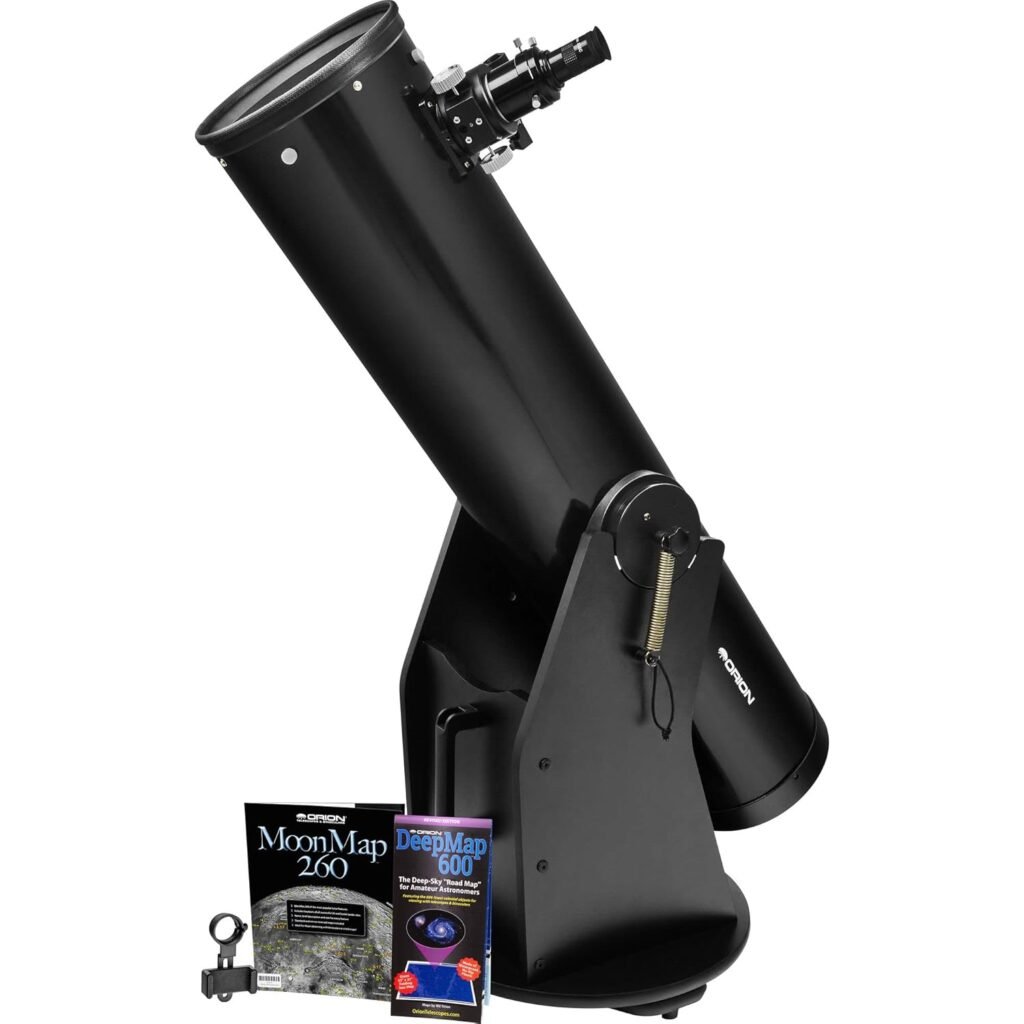
If your goal is to see faint, fuzzy galaxies and detailed nebulae, you need a light bucket. The Orion SkyQuest XT8 is arguably the most recommended entry-level aperture scope available.
Elaboration:
Dobsonian telescopes are essentially large reflector tubes mounted on a simple, sturdy wooden base. This design strips away complex electronics and expensive equatorial mounts, dedicating the budget entirely to the primary mirror. At 8 inches (203mm), this Orion telescope gathers 78% more light than the 114mm StarSense! This extra light means you can clearly resolve the spiral arms of the Andromeda Galaxy or the subtle glow of the Orion Nebula, even from suburban skies. The simple Alt-Az mount is incredibly stable, preventing the wobbles that ruin high-power viewing. It’s often called the best telescope for visual astronomy under $1000.
In-Depth Specs:
- Aperture: 203mm (8 inches)
- Focal Length: 1200mm
- Focal Ratio: f/5.9 (Excellent all-rounder)
- Mount: Dobsonian (Heavy-Duty Alt-Az)
Ideal User: The serious visual observer who wants the absolute best views possible and has a dedicated space (like a backyard) to store and use this larger instrument.
3. Celestron AstroMaster 130EQ Telescope (Best for Equatorial Mount Learning)
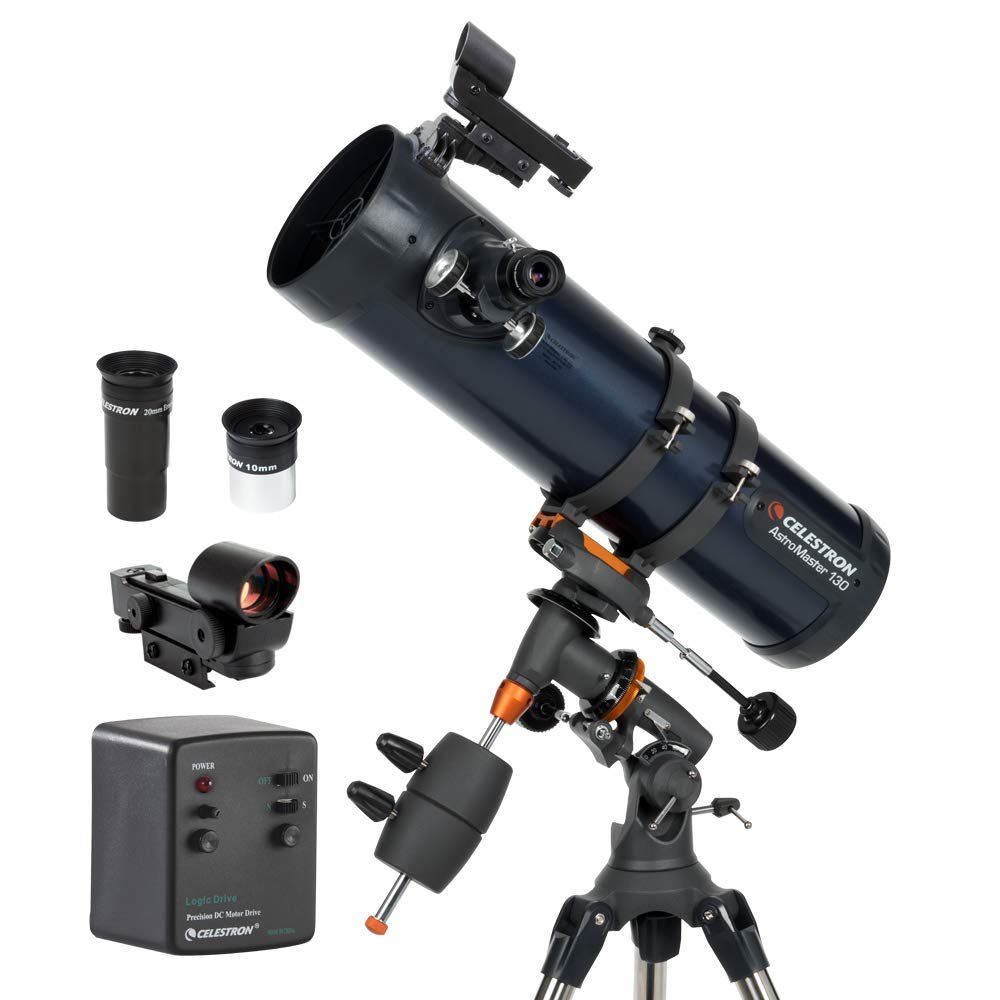
This telescope is an excellent mid-tier choice for those who are ready to graduate from the simple Alt-Az motion and learn the fundamentals of astronomical tracking.
Elaboration:
The AstroMaster 130EQ features a generous 130mm reflector tube, significantly boosting light collection over smaller refractors. The real learning tool here is the Equatorial (EQ) mount. Once you align the EQ mount to Polaris (the North Star), you can track a star or planet across the sky using only the Right Ascension slow-motion control. This prevents objects from drifting out of view—a critical skill for more advanced stargazing and an absolute requirement for any form of long-exposure astrophotography. While the included tripod can be a bit shaky, adding small weights can mitigate this.
In-Depth Specs:
- Aperture: 130mm (5.1 inches)
- Focal Length: 650mm
- Focal Ratio: f/5 (Fast focal ratio, great for wide-field views)
- Mount: German Equatorial (EQ)
Ideal User: The motivated intermediate beginner interested in learning how the sky moves and preparing for future astrophotography projects.
4. Gskyer 600x90mm AZ Astronomical Refractor Telescope (Best Budget & Portability)
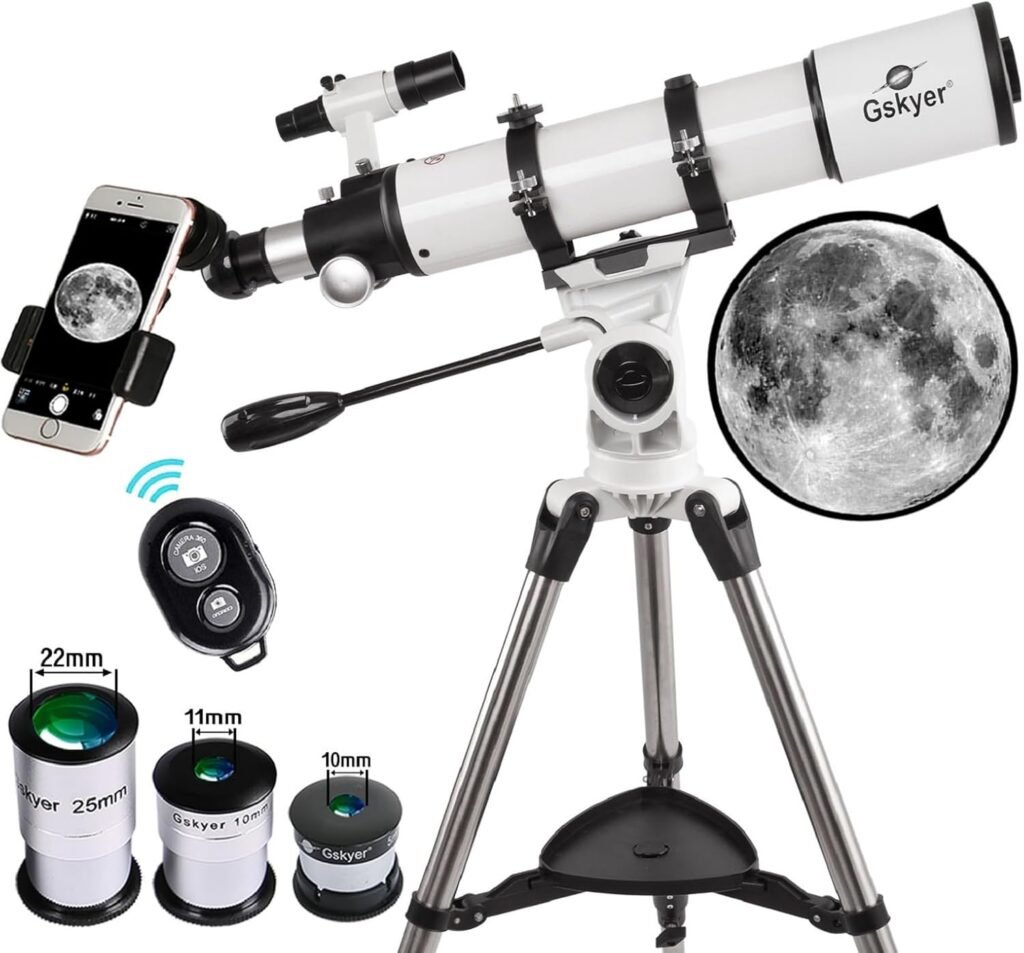
For quick, hassle-free setups and exceptional portability, the Gskyer 90mm Refractor provides clear, high-contrast images of the Moon and planets, making it an excellent entry-level telescope.
Elaboration:
Refractors, like this Gskyer model, excel at sharp, high-contrast viewing because they don’t have a secondary mirror obstructing the light path. This 90mm lens delivers stunning, crisp details on the Moon’s surface and sharp views of Venus’ phases and the major features of Jupiter. It’s light enough to be carried easily, making it perfect for taking on camping trips or to darker local parks. The inclusion of a smartphone adapter is a great feature, allowing you to easily capture the Moon through the eyepiece, which is often the first astrophotography success for a beginner.
In-Depth Specs:
- Aperture: 90mm (3.5 inches)
- Focal Length: 600mm
- Focal Ratio: f/6.7
- Mount: Alt-Azimuth
Ideal User: The casual, travel-focused stargazer, or the person looking for an affordable starter telescope that emphasizes lunar and planetary views.
5. Meade Instruments Infinity 102mm AZ Refractor Telescope (Best Quality Refractor Bundle)
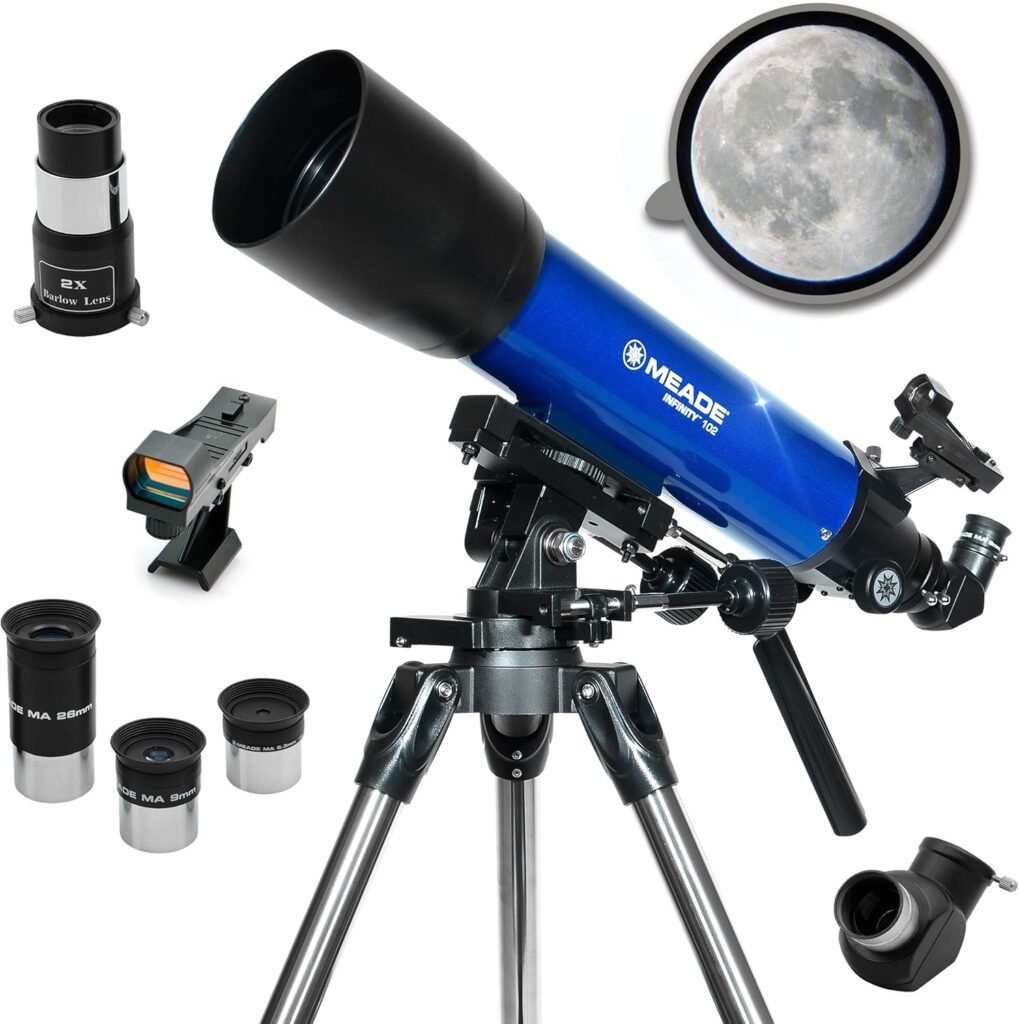
The Meade Infinity 102mm is a step up in quality and aperture from the Gskyer, offering a reputable name and robust performance in a refractor design.
Elaboration:
Meade is a globally recognized manufacturer of quality astronomical equipment. This 102mm refractor provides a wider field of view and brighter images than most smaller refracting telescopes, thanks to its larger aperture. A key advantage of this model is the inclusion of an erect-image diagonal. This prism corrects the image orientation, which is crucial if you plan to use the telescope for terrestrial viewing (looking at birds, scenery, etc.) in addition to the night sky. The smooth Alt-Az mount and three included eyepieces ensure you have flexibility right out of the box, making it one of the most complete and high-quality telescope kits for beginners on Amazon.
In-Depth Specs:
- Aperture: 102mm (4 inches)
- Focal Length: 600mm
- Focal Ratio: f/5.9
- Mount: Alt-Azimuth with slow-motion controls
Ideal User: Anyone who values the sharp, contrast-rich images of a refractor and wants a reliable, multi-purpose instrument from a premium astronomy brand.
Essential Stargazing Tips for Your New Telescope
Owning one of these top telescopes on Amazon is only half the battle. Here are crucial tips to maximize your viewing experience:
- Escape Light Pollution: The single greatest enemy of astronomy is light pollution. If possible, take your telescope away from city lights. Even 30 miles outside of a metropolitan area can dramatically increase the visibility of nebulae and galaxies.
- Allow for Cool-Down: Telescopes, especially reflectors, need time to acclimate to the outside temperature. This process, called thermal equilibrium, can take 30 minutes or more. If you skip this, heat currents inside the tube will distort the image.
- Use Low Power to Find, High Power to View: Always start with your lowest magnification eyepiece (the one with the largest millimeter number) to find and center your target. Once centered, slowly swap to a higher power eyepiece to zoom in for detail.
- Practice Collimation (Reflectors): If you choose a reflector (like the XT8 or 130EQ), you must learn to check and adjust the mirror alignment (collimation). While it sounds complicated, simple tools can make this quick and ensures the sharpest possible image.
- Observe the Moon First: The Moon is the ultimate beginner target. Its brilliance and wealth of detail (craters, mountains, rilles) are stunning through any telescope, giving you immediate confidence in your new gear.
❓ Your Cosmic Questions Answered: A Relatable Stargazing FAQ
We know buying your first telescope can lead to a few head-scratchers. Forget the complicated textbooks—here are the most common questions new stargazers ask, answered in plain English!
Q1: Will I see space objects exactly like the Hubble pictures?
A: Nope, and that’s okay!
This is the most important expectation to manage. Professional images (like the Hubble or Webb photos) are captured over many hours, using special filters, and processed by computers.
What you see through your eyepiece is the real-time, raw light collected by your telescope. Nebulae will look like faint gray or greenish “smudges” (which is actually incredible to witness!). Planets will look small, but perfectly detailed—you can clearly see Saturn’s rings and Jupiter’s major cloud bands. The sheer wonder of seeing these objects live, with your own eye, is a hundred times cooler than any photo!
Q2: What’s the deal with “Aperture is King”? Can’t I just zoom in more?
A: Magnification is cheap; light is priceless.
- Aperture is the size of the telescope’s light-collecting mirror or lens. Think of it as a bucket. A bigger bucket (larger aperture) catches more light. More light = Brighter, clearer views.
- Magnification is just how much you zoom in. If you take a blurry, dark image and zoom in 500 times, you just get a bigger, blurrier, darker image.
Always prioritize the biggest aperture you can comfortably afford and carry. It’s what truly separates a great view from a disappointing one.
Q3: Why do I have to keep moving my telescope to look at one thing?
A: That’s the Earth saying “Hello!”
It’s not your telescope; it’s the fact that our planet is spinning! The Earth rotates once every 24 hours, which makes celestial objects appear to drift across the sky surprisingly quickly (especially at high magnification).
- If you have a simple Alt-Azimuth mount (like the StarSense or Gskyer), you have to nudge it constantly.
- If you have an Equatorial (EQ) mount (like the AstroMaster), you align it once, and then you only have to turn one single knob to easily track the object for hours.
Q4: My telescope came with a little second scope attached. What is that for?
A: That’s your “Finderscope,” your essential low-power guide.
Your main telescope has a narrow field of view, making it nearly impossible to find tiny objects like planets or stars. The Finderscope (or Red Dot Finder) is a small scope with very low magnification and a wide view.
You use it like a sighting guide: find the object in the wide-view Finderscope first, center it on the crosshairs (or the red dot), and then look through the main eyepiece. This is the correct, two-step process to locate anything in the night sky!
Q5: I live in the city. Will light pollution ruin my stargazing?
A: Not at all! You can still see incredible things.
Light pollution mainly affects very faint objects, like distant galaxies and nebulae. But guess what? The Moon and the major planets are so bright they punch right through city lights!
With any of the top 5 telescopes on Amazon, you can enjoy stunning views of:
- The Moon: Every crater and ridge is visible.
- Jupiter: Cloud bands and up to four of its largest moons.
- Saturn: Its beautiful, unmistakable rings.
- Mars & Venus: Their phase changes and surface features (when they are visible).
For the really deep-sky stuff, you might need to take a quick road trip, but you can get started right in your backyard.
Q6: Can I take pictures with my beginner telescope?
A: Yes, absolutely! Start with your phone.
The easiest way to begin astrophotography is by using a smartphone adapter (often included, or cheap to buy). You simply clamp your phone over the eyepiece and snap a picture. You will be amazed at the detail you can capture of the Moon and the planets!
For long-exposure photos of galaxies and nebulae, you would need a much more expensive, motorized equatorial mount, but you can certainly start with fantastic lunar photography right now.
🔭 Launching Your Cosmic Journey: Final Verdict and Next Steps
Choosing from the top 5 telescopes on Amazon is a personal decision based on your priorities: guided ease-of-use (StarSense), raw light-gathering power (XT8), or balanced learning (AstroMaster/Meade/Gskyer). Each of these instruments offers an incredible window into the universe.
The most powerful telescope is the one you use the most. Don’t let the technical terms intimidate you. The joy of locating Jupiter for the first time or seeing the ghostly light of a distant star cluster will eclipse any initial confusion. This is the best telescope market we’ve seen in years, making it the perfect time to start.
Your next step is simple: Stop dreaming and start discovering! Click on the telescope that speaks to your inner explorer right now on Amazon to secure your new view of the universe. Then, come back to mindgearmen.com for more advanced tips, tricks, and accessories to become a master astronomer! Clear skies await!